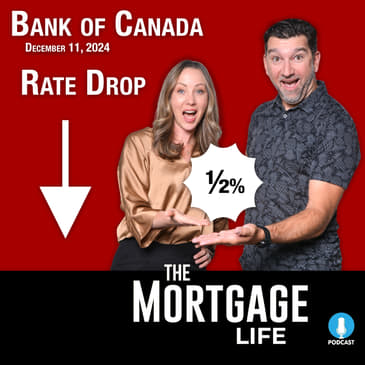
Christmas presents being given out by the Bank of Canada? Yup, that's right! The Bank of Canada announced today that they're cutting the overnight rate by 1/2% to 3.25% today. That means variable rate mortgage clients and those with lines of credit should see some relief in their rates shortly. Tune in to get our take on what happened and where we're going in 2025.
[00:00:00] Well hello! Interest rate announcement day and we got an early Christmas present, didn't we Pete?
[00:00:11] You've landed on the Mortgage Life Podcast where we strive to bring you mortgage related info that's easy to understand.
[00:00:19] We have conversations with market experts to bring you timely updates. Because there's one certainty in this industry, things change.
[00:00:29] I'm Mindy Baudwin.
[00:00:30] And I'm Pete Salomose. Welcome to The Mortgage Life Podcast.
[00:00:39] That's right, so it is December 11, 2024, which is Bank of Canada announcement day, two weeks before Christmas and the Bank of Canada decided that they weren't going to give lumps of coal.
[00:00:51] Tis the season for gifting. So what did they give us today, Mindy?
[00:00:56] They did a 0.5 reduction in their key policy rate. And interestingly, actually, Pete and I have
[00:01:04] a quick chat yesterday to kind of make some predictions. And we both thought it was going to be a 0.25.
[00:01:12] I understand the labor numbers were not ideal and we can get into that in a minute, but there's so many other things happening in the world and in the economy as a whole right now that we thought maybe it would be
[00:01:22] be a 0.25, but we got a whole 0.5. Merry Christmas, Canadians.
[00:01:28] Yeah, absolutely. And so strange because I have to admit my prediction was going to be more like zero or maybe a quarter percent just because of the instability in the market.
[00:01:39] So I'm glad I was wrong. And you're welcome, everyone, for being wrong.
[00:01:43] Yeah, maybe we better do that more often.
[00:01:46] So, so we had some commentary by some economists this morning and we just want to give you a little bit of a high level overview of some of the discussion.
[00:01:55] So you understand why the Bank of Canada has made this change and perhaps where they're looking to go in the future.
[00:02:02] Yeah, so in general, as we were watching rates increase, we are always talking about how the Bank of Canada was trying to target an inflationary rate of around 2%.
[00:02:13] So we've been hitting that target since mid-summer.
[00:02:17] And in fact, in this last quarter, the economy grew at a lower level than what they were anticipating.
[00:02:26] So when you have your inflationary target met, the economy is growing at a lower rate than anticipated.
[00:02:33] A thing that the Bank of Canada will do is lower interest rates to kind of stimulate the economy.
[00:02:40] In addition to the economy not being as healthy as they were hoping, the big thing that happened is the unemployment rate rose.
[00:02:49] Well, exactly. And that unemployment rate, again, it's not a great sign.
[00:02:55] It means that there's fewer jobs out there. There's fewer people able to spend the money.
[00:03:00] So typically, that results in some sort of stimulus by the Bank of Canada.
[00:03:03] That means that the rates could potentially come down. And again, that seems to have affected it as well.
[00:03:09] So what they're doing, lowering the interest rate is effectively increasing the money supply.
[00:03:16] Just some little technical notes here.
[00:03:18] So when you increase the money supply, it's because money is cheaper to borrow.
[00:03:21] So more people borrow it. More money goes into the economy. It stimulates the economy.
[00:03:26] That's kind of how that works with economics 101.
[00:03:31] One potential side effect of this, though, is and this is another thing that we're seeing in the news,
[00:03:36] is the Canadian dollar may go down a little bit more compared to the US dollar.
[00:03:40] So we're pretty low right now, 70 cents. They're thinking it could go down to 68 cents.
[00:03:45] We've been more aggressive on our rate reductions than the US has.
[00:03:49] So our value of our dollar is less compared to the US dollar.
[00:03:55] So something to think about.
[00:03:56] For sure. And it is an interesting kind of side effect to it.
[00:04:00] So, again, there's a lot of weird economic bits and pieces that filter out of it.
[00:04:05] Of course, one of them is that exchange rate.
[00:04:08] I just wanted to review one last thing on this.
[00:04:11] And we kind of try to be not super technical.
[00:04:14] But I wanted to kind of give you the exact wording from the Bank of Canada,
[00:04:19] because I think it's really interesting.
[00:04:21] And it kind of gives us some sense of where they're going in the future.
[00:04:24] So into 2025, where are things headed?
[00:04:27] So this is a quote from the Bank of Canada.
[00:04:29] With inflation around 2%, the economy in excess supply and recent indicators
[00:04:35] tilted towards softer growth than projected.
[00:04:38] The governing council decided to reduce the policy rate by a further 50 basis points
[00:04:42] to support growth and keep inflation close to the middle of the 1% to 3% target range.
[00:04:49] So basically, they're just saying what we've done in the past has kind of worked.
[00:04:54] We don't want to leave it too much in that restrictive phase.
[00:04:59] So we're going to drop the rate.
[00:05:01] So we're kind of trying to maintain the middle of that boundary range, which is kind of cool.
[00:05:06] It means that the kind of suffering that we all went through in the last couple of years has worked.
[00:05:11] And now we're tempering back to normal.
[00:05:16] Yes, exciting.
[00:05:17] Especially starting a new year, right?
[00:05:19] A new year, a new leaf.
[00:05:20] I think it's a positive move.
[00:05:22] So now, what does this mean?
[00:05:24] What does this mean to you?
[00:05:26] You have a mortgage.
[00:05:27] Okay, so I need to say this very clearly.
[00:05:31] If you have...
[00:05:32] We get this asked so much.
[00:05:34] This is the most common question.
[00:05:36] Three times since the last week.
[00:05:38] If you have a fixed rate mortgage, your payment will not change, period.
[00:05:46] Exactly.
[00:05:46] And in addition, if you have a pre-approval for a fixed rate mortgage, this will most likely not affect it.
[00:05:53] This is purely on the variable side.
[00:05:57] Correct.
[00:05:58] And even on the variable side, there's two different categories.
[00:06:01] And Pete's actually typed up some pretty good examples here, which shows you like dollar savings in your pocket.
[00:06:08] So go ahead, Pete.
[00:06:09] Let's see what happens if you have a $500,000 mortgage right now.
[00:06:14] I chose $500,000 because it's a nice round number.
[00:06:17] If you've got a million dollar mortgage, congratulations, that's a huge mortgage.
[00:06:21] But it can be easily adjusted just times it by two.
[00:06:24] And if you have a $100,000 mortgage, you just divide by five.
[00:06:27] So here we go.
[00:06:28] A $500,000 mortgage.
[00:06:30] This is going to be on an adjustable rate mortgage.
[00:06:33] So that means that with an adjustable rate, your payment changes as the rate changes.
[00:06:40] So you have felt this on the way up.
[00:06:42] As rates went up, your payment went up.
[00:06:44] And oh my gosh, that was very painful.
[00:06:47] But thankfully, they're going down.
[00:06:49] So today, if your rate is on an adjustable rate mortgage, and let's say you have a prime minus half a percent rate,
[00:06:56] then your rate would be 5.45.
[00:06:59] Your payment would be $3,055.53 based on a 25-year amortization.
[00:07:08] Now, with that rate going down a half a percent today, your new rate, hopefully when your lender catches up,
[00:07:16] it might be today, could be tomorrow, could be the end of the month.
[00:07:19] Whenever they change, and they will change, your new rate will be 4.95%, assuming that they go the full half percent.
[00:07:28] Most lenders will most likely do that.
[00:07:30] That's historically been the case.
[00:07:32] With your new rate being 4.95, your new payment will be $2,908.40.
[00:07:41] What difference is that?
[00:07:42] Well, that's nearly $150 difference in payment.
[00:07:46] Your payment is going to drop by $150 per month.
[00:07:50] Yeah, that's pretty amazing.
[00:07:52] You can actually see how that's going to impact you directly.
[00:07:57] And typically, when you're getting a mortgage, a lot of the time, when you have that sort of adjustable or variable,
[00:08:03] it's lumped into variable.
[00:08:04] I just find that a lot of people think that a variable rate, but there is actually a difference between adjustable and variable.
[00:08:11] And different institutions do it.
[00:08:13] So, for example, this adjustable way is something that Scotiabank does with their mortgages.
[00:08:18] That's right.
[00:08:20] So, if you have a variable rate mortgage, this is one of those weird ones where your rate is going to change as the prime rate changes,
[00:08:28] but your payment stays static.
[00:08:30] So, your payment actually doesn't change.
[00:08:32] So, in this case, again, same example, $500,000 mortgage.
[00:08:36] Your current rate is 5.45.
[00:08:38] Your rate will drop to 4.95.
[00:08:41] Again, assuming the banks all match that 50% rate or 50 basis point rate drop.
[00:08:47] Your payment, of course, beforehand would have been $3,055.53.
[00:08:52] It's going to stay at $3,055.53.
[00:08:57] So, what here is the difference?
[00:08:59] Well, the difference is your amortization.
[00:09:02] So, the period of time in which it takes you to pay off your mortgage will actually decrease.
[00:09:07] And here's the big one.
[00:09:09] This is actually a huge drop.
[00:09:11] So, your amortization goes from 25 years down to 22 years, 9 months.
[00:09:15] It has knocked nearly two and a half years off your amortization.
[00:09:21] A 0.5 interest rate reduction, nearly two and a half years off your amortization period.
[00:09:28] That's remarkable.
[00:09:30] Right.
[00:09:30] I was just going to give an example of a financial institution that handles rate reduction this way,
[00:09:36] and that would be TD Canada Trust.
[00:09:39] Right.
[00:09:39] Yeah.
[00:09:40] So, some cool stuff.
[00:09:42] Check with your broker.
[00:09:43] Check with us.
[00:09:44] If you've got questions about how this affects you,
[00:09:46] whether you've got a variable rate mortgage, adjustable rate mortgage,
[00:09:49] or if you have a line of credit, this will also be affected.
[00:09:53] And that could be a home equity line of credit or an unsecured line of credit.
[00:09:56] This will have an effect on you.
[00:09:58] So, give us a dingle.
[00:10:00] Welcome to a fantastic, hopefully new dawning of a variable rate day.
[00:10:05] This is some good news.
[00:10:08] I think, you know, we've got a lovely Christmas present from the Bank of Canada.
[00:10:14] Here's hoping that we kind of stay strong and we finish out this year.
[00:10:18] Fantastic.
[00:10:19] Mindy, when's the next Bank of Canada reading?
[00:10:21] Yeah, good question.
[00:10:23] I know.
[00:10:23] Because they don't do it every month.
[00:10:25] They do it eight times a year.
[00:10:27] And so, this was such a great gift.
[00:10:29] I'm thinking, oh, is it not going to be until February?
[00:10:31] But it's actually next month.
[00:10:34] There's another interest rate announcement next month, January 29th of 2025.
[00:10:39] So, stay tuned.
[00:10:41] It'll be interesting to see what the Bank of Canada does then.
[00:10:44] This is The Mortgage Life.
[00:10:45] We look forward to continuing the conversation.
[00:10:47] So, come back and listen.